
Between Editions: For All the World to See
History will be the judge

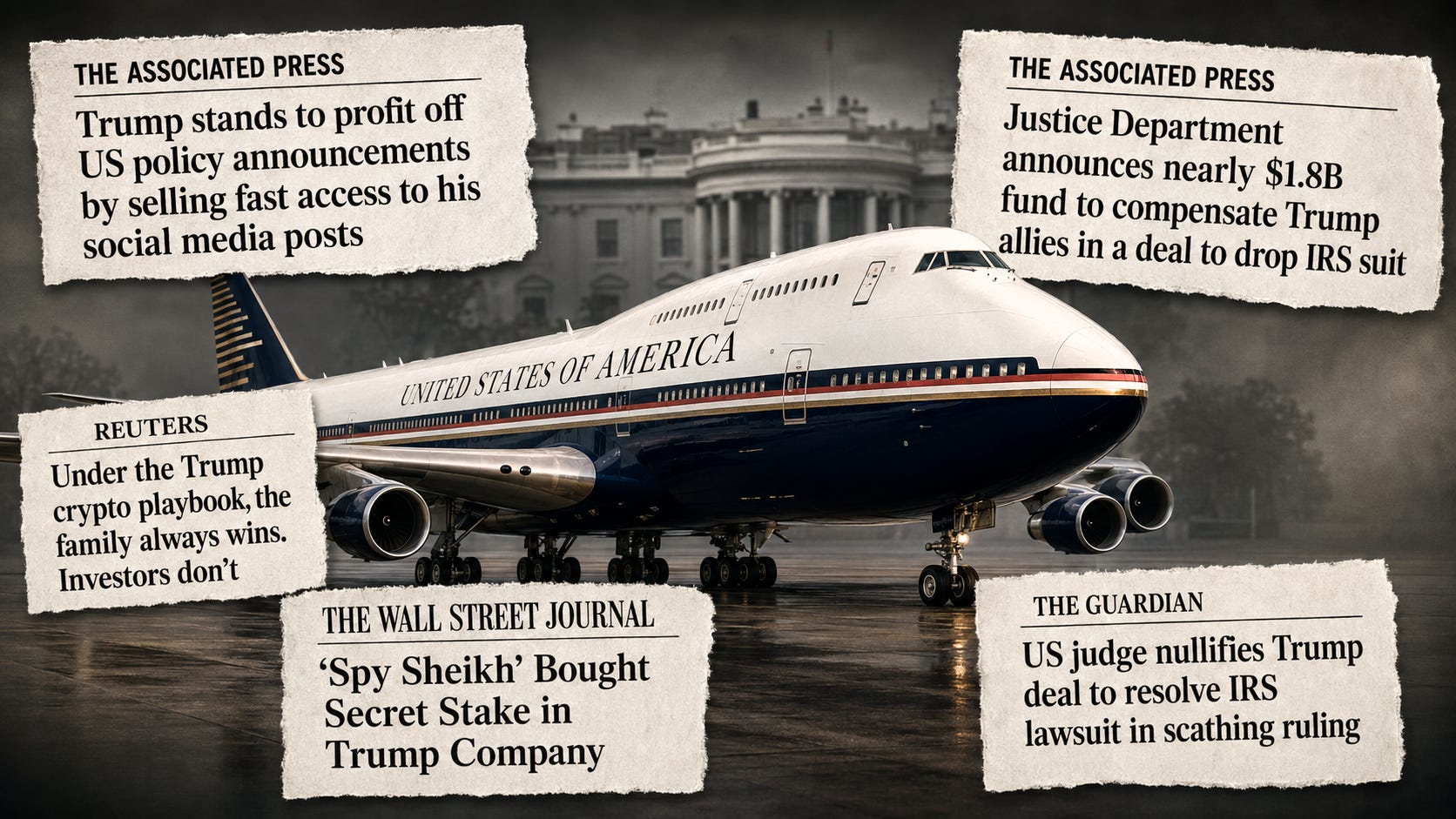
Past American presidents generally tried to keep some distance between the power of the White House and the pursuit of personal wealth. President Donald Trump appears to have no such qualms.
Businesses tied to him and his family have expanded, attracted foreign money and benefited from decisions made by his administration. The pattern has become so open and routine that conduct once capable of consuming a presidency now passes as another part of governing.
Asked by The New York Times in January why he had abandoned restrictions placed on his family’s business ventures during his first term, Trump said he received no credit for showing restraint. “I found out that nobody cared,” he said.
His second term is testing that conclusion. Trump Media now charges Wall Street for faster access to posts announcing decisions that can move markets.
The information is generated by Trump’s public office, carried on a platform tied to his personal wealth and packaged for traders willing to pay as much as $100,000 a month. No envelope stuffed with cash is required. The presidency creates the valuable information, Trump Media sells the speed advantage and wealthy traders gain an edge unavailable to ordinary investors.
Selling presidential news by the millisecond
The service, called Truth API, delivers machine-readable versions of influential Truth Social posts directly to financial firms. Trump Media maintains that paying customers and the public receive the posts at the same time, but traders purchasing the feed can process the information and place orders more quickly than someone reading a post on a telephone.
Trump uses Truth Social to announce or threaten changes involving tariffs, wars, central bank leadership and individual companies. Financial firms can buy or sell before most investors have finished reading.
“For the big guys, it’s going to be something they need,” Joe Saluzzi, co-founder of Themis Trading, told The Associated Press. “It’s market-moving information.” Institutional traders can react within fractions of a second.
The financial connection is direct. Trump Media filings show that Trump’s revocable trust owns 41 percent of the company. Trump is its sole beneficiary, while Donald Trump Jr. is the trustee.
Truth API could provide meaningful income to a struggling company. Trump Media reported $3.7 million in sales during 2025 while losing more than $700 million. Three customers paying $100,000 a month would nearly match its annual sales.
Trump Media argues that the service uses publicly released information. That avoids the central problem. This is not an ordinary media company selling faster access to someone else’s news. It is a company partly owned for Trump’s benefit selling faster access to information he creates while exercising presidential power.
A fortune from an industry he regulates
Truth API is not an isolated venture. Trump and his family have made extraordinary sums from cryptocurrency while his administration has promoted the industry, eased enforcement and shaped the rules governing it.
A Reuters investigation estimated that Trump family cryptocurrency ventures had generated at least $2.3 billion in profits since he returned to the presidency. Outside investors in those projects had combined losses of roughly the same amount by the end of April, including losses that had not been realized through sales.
Trump’s financial disclosures showed how cryptocurrency transformed his conventional holdings. Reuters found that his portfolios of stocks and bonds increased at least fourfold during 2025 as proceeds from digital assets flowed into traditional investments. The White House said Trump did not manage the accounts and that administration policies were made in the public interest.
The New Yorker attempted to measure the larger gains. Reporter David D. Kirkpatrick estimated that the amount Trump and his immediate family had gained by leveraging the presidency had reached more than $4 billion after the first year of his second term.
That is an estimate, not an audited total or cash collected during 2025 alone. Kirkpatrick excluded existing properties, political contributions and some paper wealth. Even so, the total was unprecedented.
Foreign money creates an even sharper conflict. Four days before Trump’s second inauguration, investors backed by Sheikh Tahnoon bin Zayed Al Nahyan, the United Arab Emirates’ national security adviser, agreed to pay $500 million for a 49 percent interest in World Liberty Financial, the Trump family’s cryptocurrency venture.
The Wall Street Journal reported that $187 million of the initial payment went to Trump family entities. Months later, the administration approved expanded Emirati access to advanced American artificial intelligence chips. The White House and World Liberty denied any connection.
The conflict remains. A senior foreign official acquired a major interest in a company benefiting the president’s family while seeking a valuable national security decision from his administration.
The Qatari aircraft makes the problem easier to see. Qatar gave the United States a luxury Boeing 747 valued at roughly $400 million, which the federal government converted for Trump’s use as Air Force One at a cost that has not been fully disclosed. Trump began flying aboard it in July.
Trump said the aircraft saved taxpayers money. Qatar denied expecting influence in return. The plane belongs to the government while Trump uses it, but ABC News reported that it is expected to be transferred to his presidential library foundation shortly before he leaves office.
A foreign government supplied an aircraft Trump wanted, taxpayers prepared it for his use and the plane may eventually pass to his library. It is not how a healthy government keeps foreign influence at a safe distance.
The government settles with itself
The Internal Revenue Service arrangement involved Trump using control of the executive branch to seek protection from the agency responsible for examining his taxes. Trump, his two oldest sons and the Trump Organization sued the IRS and Treasury Department for $10 billion over the illegal disclosure of their tax records.
Trump was the plaintiff, but the agencies he sued belonged to the government he controlled. His Justice Department did not mount the vigorous defense normally expected when a private party seeks billions from taxpayers. Instead, the two sides produced an agreement under which Trump dropped the lawsuit and received a formal apology.
The agreement created a $1.776 billion Anti-Weaponization Fund for people claiming they had been unfairly investigated or prosecuted. A panel appointed by the attorney general would select the recipients.
A separate order signed by acting Attorney General Todd Blanche purported to release Trump, his relatives, his companies and numerous affiliates from government claims involving previously filed tax returns. Republican Sens. John Cornyn of Texas and Thom Tillis of North Carolina joined Democrats in objecting.
Cornyn told Reuters that the agreement offered protection from audits “that no other taxpayer could possibly get.” The senators demanded written assurances that the fund and tax protections had been abandoned.
U.S. District Judge Kathleen Williams found that Trump and his own administration were never truly opposing parties. She concluded that the lawsuit had been used to provide legal cover for an agreement benefiting Trump and his allies.
“This action was never about a party seeking judicial resolution of a legal issue or a factual dispute,” Williams wrote. She said it was an attempt to legitimize immunity for people and businesses affiliated with the president while earmarking billions of taxpayer dollars for grievances not recognized in law.
Under that pressure, Blanche issued written orders formally rescinding the fund and narrowing the tax protections. The Senate Judiciary Committee then voted along party lines on Aug. 4 to advance his nomination as attorney general.
The protection from tax scrutiny was not eliminated. It now applies to Trump, Donald Trump Jr., Eric Trump and the Trump Organization for tax matters that existed when the settlement was reached. It does not cover future returns. The Associated Press reported that the arrangement still could eliminate more than $100 million in potential back taxes and penalties.
Judge Williams did not void the tax agreement. She ruled that Trump’s lawsuit had been filed for an improper purpose and prohibited the government from presenting the settlement as the product of a legitimate adversarial proceeding. Trump has appealed her ruling.
The surviving arrangement remains one of the strongest examples of self-dealing in the administration. The president, his sons and his company retain protection from tax claims that ordinary taxpayers could still face. Political pressure forced the fund’s rescission, but the tax protection survived and the episode revealed how far the administration was prepared to go.
Why no scandal breaks through
Presidents are exempt from the principal federal conflict-of-interest laws applying to most executive officials. The system therefore depends on disclosure, voluntary restraint, congressional oversight and political pressure. Many of those safeguards are norms rather than enforceable barriers.
Republicans control Congress and have shown little interest in investigating his family’s businesses. Trump removed inspectors general, while financial regulators, law enforcement and tax officials answer to his appointees. News organizations can uncover conflicts but cannot force the government to act.
The lack of consequences is not public approval. A Brennan Center for Justice poll found that 92 percent of voters considered corruption a major problem, including 90 percent of Republicans and 93 percent of Democrats and independents.
The agreement extended to what corruption means. Ninety-seven percent said a government official using public office for personal gain qualified as corruption. Eighty-nine percent believed corruption produced policies benefiting billionaires and large corporations at the expense of ordinary Americans.
Nearly two-thirds viewed corruption as embedded in the political system rather than a collection of individual choices. That may explain why disclosures about Trump’s wealth have not produced the response earlier scandals did. They confirm what many voters already believe.
Watergate changed how Americans thought about corruption because it exposed a presidential cover-up and showed that institutions could impose consequences. Congress investigated, courts enforced subpoenas, Republicans withdrew their support and Richard Nixon resigned.
Even Vice President JD Vance has acknowledged how differently such a scandal might land today. “If Watergate happened tomorrow, it would be like a 12-hour news story,” he said during a June appearance at the Richard Nixon Presidential Library. “The idea that it would have taken down a presidency is crazy.”
Vance intended the remark as a defense of Nixon. Yet his description captured something important. A flood of controversies can protect a president by exhausting the public’s ability to absorb them.
Each disclosure competes with the one before it until an aircraft, cryptocurrency deals, tax protection and the sale of presidential information become background noise. What once might have defined an administration becomes another headline in an afternoon news cycle.
Trump’s defenders argue that he remains entitled to conduct business, that voters knew he was wealthy and that no court has found a criminal exchange of money for an official favor. Those points matter, but they do not answer the central question.
Corruption is not limited to envelopes of cash or criminal convictions. It includes using public authority to create private gain, protect personal interests or make decisions clouded by financial obligation. By the public’s definition, using office for personal benefit is corruption whether charges are filed or not.
Truth API is a fitting symbol of the larger problem. Public office creates the information, a company benefiting Trump sells the speed advantage and wealthy customers receive the better product. The Qatari plane converts a foreign relationship into a luxury presidential aircraft that may eventually pass to Trump’s library.
The IRS agreement attempted to turn control of government into protection from tax scrutiny and a compensation fund for allies. The cryptocurrency ventures allow the Trump family to profit from an industry whose treatment is being determined by Trump’s administration.
Axios co-founder and CEO Jim VandeHei wrote that Trump would “use levers of power to keep raising money to expand his clout beyond the presidency.” Not every dollar raised will become personal income, but the pattern reflects Trump’s view that money and political power strengthen each other. The presidency provides the leverage to accumulate both.
None of these episodes alone proves every allegation made against Trump. Together, they describe an administration in which the boundary between governing and personal benefit has nearly disappeared.
History may judge the second Trump administration as one of the most corrupt in American history, not because its transactions were hidden, but because so much happened in plain sight. Trump is betting that nobody cares. The evidence suggests Americans care but doubt the system will respond.
Between Editions is a free weekly feature of The Rising Tide that examines the political forces shaping the United States and the wider world. It looks at power, policy and political conduct with a calm tone and an independent eye. Its conclusions may not please everyone, but they are grounded in documented facts rather than party loyalty. Every edition is open to all, with no subscription required.