
Between Editions: American Democracy Under Attack
A free feature of The Rising Tide. No subscription needed to read.

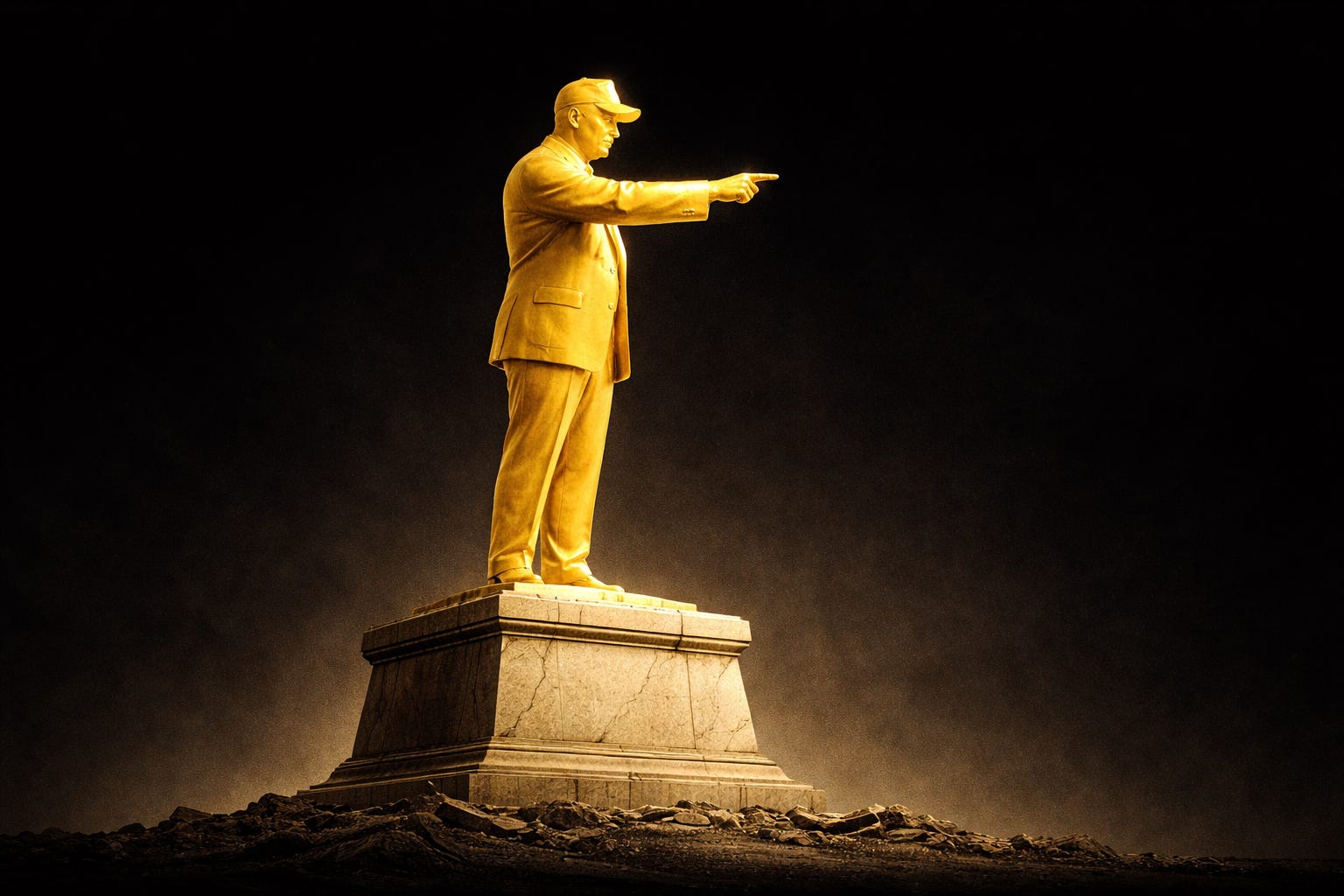
Most democracies do not collapse overnight. They rarely fall because tanks roll into the capital or because a general announces a coup. More often they weaken slowly in ways that can be hard to recognize while they are happening.
The trouble usually begins when leaders stop thinking of power as something temporarily entrusted to them and start treating it as something that belongs to them personally. Once that shift takes hold, the rules that limit authority begin to feel less like safeguards and more like obstacles.
And when that happens, the central question of politics changes. It is no longer simply how someone gains power. It becomes whether they believe they are ever supposed to give it back. That tension now sits at the center of American political life. It can be seen both in how power is exercised and in how institutions are being tested. The contrast between the country’s founding precedent and its current political culture has rarely been sharper.
I have long believed that the American Revolution was the most important political event in the history of the modern world. Not because the people involved were perfect. They were not. But because the idea they launched changed the way human beings understood power itself.
Historian and filmmaker Ken Burns expressed that same conviction while promoting his 2025 documentary series, The American Revolution. In an interview with CBS News, Burns made a striking comparison.
“I think the American Revolution is the most important event since the birth of Christ in all of world history,” he said. “It turned the world upside down… before this moment, everyone was a subject, essentially under the rule of somebody else. We had created in this moment a very brand-new thing called a citizen.”
Burns has repeated that argument in multiple interviews, describing the Revolution as a “moment of creation” for the modern political world. His point is not theological hyperbole but historical scale. Just as the birth of Christ reshaped the moral and spiritual landscape of Western civilization, Burns argues that the Revolution reshaped its political landscape.
Before 1776, nearly every society on earth organized power around hierarchy. People were born into status, be they subject, noble, serf, or monarch. Authority flowed downward. Rights, when they existed, were granted by rulers. The Revolution introduced a radically different premise: that sovereignty begins with the individual citizen.
The most famous expression of that idea appears in the second sentence of the Declaration of Independence. “We hold these truths to be self-evident,” Thomas Jefferson wrote, “that all men are created equal, that they are endowed by their Creator with certain unalienable Rights.”
Burns often calls that sentence one of the most powerful ever written in the English language. Once spoken aloud, he argues, it shattered the assumptions that had governed political life for centuries. If rights were inherent rather than granted, then monarchy itself was suddenly open to challenge.
Of course, the Revolution was never as clean or pure as its language suggested. Burns frequently describes it as America’s first civil war. Families were divided between Patriots and Loyalists. Violence was widespread. The new nation was born with a glaring contradiction: the continued existence of slavery.
But Burns’ point and the one that matters for understanding American democracy is that the idea itself proved stronger than the imperfections of the people who launched it. Over time, the same language used to justify independence would become the moral foundation for movements that expanded freedom far beyond what the founders imagined.
The American Revolution created the citizen. The next question was whether citizens entrusted with power would ever willingly surrender it.
The Standard Set by Walking Away
On Presidents Day earlier this year, former President George W. Bush published a short essay as part of a nonpartisan history project marking the approach of America’s 250th anniversary. His essay avoided contemporary politics entirely. It did not debate policy or criticize current leaders. Instead, it returned to a single decision that shaped American governance more than almost any constitutional clause: George Washington’s choice to relinquish power.
“Few qualities have inspired me more than Washington’s humility,” Bush wrote. He pointed to two moments when Washington could have consolidated authority and chose not to, first by surrendering command of the Continental Army after the Revolutionary War, and later by stepping down from the presidency after two terms.
By “relinquishing power rather than holding onto it,” Bush argued, Washington ensured that the United States would not drift toward monarchy or worse.
Bush did not present Washington as a flawless figure. He acknowledged Washington’s lifelong entanglement with slavery, noting that the first president “was — as were so many of his generation — a lifelong slave owner who never publicly condemned the institution.” Washington’s decision to free the people he enslaved in his will does not erase that stain. The point of the essay was not sanctification. It was precedent.
Washington’s most important contribution to American democracy was not battlefield victory or constitutional design. It was voluntary limitation. He demonstrated that power could be surrendered even when it could be kept.
From Office to Identity
One year into his second term, Donald Trump’s effort to present himself as the dominant symbolic figure in American life has become so constant that it barely registers as unusual anymore. The presidency is no longer simply an office. It is increasingly portrayed as an extension of the individual who holds it.
Trump has always been a master of branding. Long before politics, his name appeared on hotels, casinos, aircraft, bottled water, neckties and steaks. But what began as commercial promotion has expanded into something larger in scale and intent.
His image and name now appear across government and political life with unusual frequency. Proposals and symbolic gestures have floated through Washington suggesting that Trump’s name be attached to airports, infrastructure projects and cultural institutions. Supporters have commissioned statues and public displays celebrating his presidency. Some have even raised the idea of adding his face to Mount Rushmore.
Presidential historian Michael Beschloss described the logic behind the phenomenon in an interview with The New York Times. “This is not just egotistical self-satisfaction,” he said. “It’s a way of expanding presidential power.”
The underlying message is simple. A leader who becomes ever-present in public life appears larger than the office itself. That shift matters because democratic systems are built around the opposite assumption: that offices endure while individuals pass through them.
What the Global Data Shows
Concerns about democratic erosion are not limited to American commentators. Increasingly, they are being documented by global research institutions that track the health of political systems.
One of the most widely respected of these organizations is the V-Dem Institute at the University of Gothenburg in Sweden. Each year the institute publishes one of the most comprehensive datasets on the condition of democracies worldwide, using dozens of indicators to measure political rights, institutional independence, press freedom, and the balance of power between branches of government.
Its most recent report paints a sobering picture. By 2025, nearly a quarter of the world’s countries were experiencing democratic backsliding, a measurable shift toward more authoritarian forms of governance. The trend is no longer confined to fragile states or developing economies. Six of the ten countries newly identified as undergoing democratic regression are located in Europe and North America, including Italy, the United Kingdom, and the United States.
The report’s most unsettling conclusion concerns the United States itself. According to the institute’s researchers, the country that once served as a model for liberal democracy has now fallen out of that category. In the V-Dem classification system, the United States no longer qualifies as a long-standing liberal democracy and is instead experiencing what the report describes as rapid “autocratization.”
Staffan Lindberg, the political scientist who founded the institute, put the finding in stark historical terms. “Our data on the United States goes back to 1789,” Lindberg said. “What we are seeing now is the greatest democratic backsliding the country has ever seen.”
The institute argues that the erosion is being driven primarily by the concentration of power in the presidency. In the first year of his current term, President Trump signed more than 200 executive orders while Congress passed fewer than 50 new laws. At the same time, the report points to growing pressure on civil liberties and a sharp decline in press freedom.
Globally, the numbers are equally sobering. Forty-one percent of the world’s population now lives in countries where democratic institutions are weakening. In total, roughly three quarters of humanity lives under some form of autocratic rule.
The most frequently attacked democratic principle worldwide is freedom of expression, followed closely by freedom of association and the integrity of electoral systems. The result, according to the institute, is that the average global citizen now lives under political conditions similar to those of the late 1970s, erasing much of the democratic progress that followed the end of the Cold War.
The Collapse of Restraint
Historically, cults of personality are associated with authoritarian regimes. The familiar examples are Joseph Stalin, Mao Zedong and Benito Mussolini, leaders who fused the identity of the state with their own public image.
Trump has shown little discomfort with the comparison. At the World Economic Forum in Davos earlier this year, he joked openly about authoritarian leadership. “Usually they say, ‘He’s a horrible dictator-type person, I’m a dictator,’” Trump said. “But sometimes, you need a dictator.”
Former aides have described the president’s fixation on personal symbolism as part of a broader transformation of the presidency. Sarah Matthews, a former deputy White House press secretary who resigned after the January 6 attack on the Capitol, said Trump’s approach to leadership has increasingly focused on elevating his personal stature.
“The presidency has become more about elevating one man than serving the country,” she said.
Earlier presidents were often acutely aware that they were setting precedent. Washington rejected aristocratic titles and insisted on the modest form of address “Mr. President.” Although the capital was eventually named after him, historians find no evidence that Washington encouraged the decision.
Most monuments associated with American presidents were erected long after their deaths. Jennifer Mercieca, a communications scholar at Texas A&M University, captured the distinction in an interview with The New York Times. “Presidents don’t name things after themselves,” she said. “People name things after presidents.”
The difference is subtle but important. One reflects public judgment. The other reflects personal demand.
Lawfare Meets Its Limits
Political combat in the United States increasingly migrates from campaign rallies to courtrooms. Each party accuses the other of weaponizing the legal system. Yet the pattern that often emerges is simpler: when legal theories stretch too far beyond precedent, courts tend to push back.
A recent dispute involving Defense Secretary Pete Hegseth and Senator Mark Kelly illustrates the point. Kelly, a retired Navy captain who now represents Arizona in the Senate, recorded a video reminding service members that they have a duty to refuse unlawful orders. The comments came amid heightened tensions surrounding the war with Iran.
President Trump responded angrily, calling Kelly’s statement “SEDITIOUS BEHAVIOR, punishable by DEATH!” Hegseth followed by issuing a formal letter of censure and launching a review that could have stripped Kelly of his military retirement rank and pension.
The effort quickly stalled in federal court. Judge Richard Leon issued a preliminary injunction halting the proceedings, writing that the Pentagon’s legal argument stretched beyond any existing precedent. Restrictions on speech that apply to active-duty military personnel, he noted, have never been extended to retired service members serving in Congress.
“If legislators do not feel free to express their views and the views of their constituents without fear of reprisal by the Executive, our representative system of Government cannot function!” Leon wrote.
The ruling reinforced a recurring theme in American governance: when political actors attempt to push legal boundaries too aggressively, the judiciary often becomes the stabilizing institution.
War and the Pressure on the Press
The war with Iran is placing pressure on more than one democratic institution at once. It has revived an old constitutional tension between the presidency and Congress while also opening a new confrontation between the administration and the press.
The constitutional issue surfaced at the outset of the conflict. The United States entered the war through presidential action, with Congress informed afterward through the War Powers reporting process rather than consulted beforehand. That sequence has become increasingly common in modern conflicts, but it sits uneasily with the Constitution’s original design, which placed the authority to declare war in the hands of the legislature.
At the same time, the conflict is creating growing friction between the administration and news organizations covering the war. In recent weeks, federal officials have criticized major outlets for their reporting. President Trump has accused parts of the media of undermining the war effort, while Defense Secretary Pete Hegseth has publicly challenged reporting from several outlets, including CNN.
The Federal Communications Commission has also entered the dispute. FCC Chairman Brendan Carr warned broadcasters that they must operate in the “public interest” when covering the war, suggesting that broadcast licenses could face scrutiny when they come up for renewal. The warning immediately raised alarms among media organizations and legal scholars.
Broadcast licenses exist because the airwaves are publicly regulated, but the system was deliberately designed to prevent political leaders from using licensing authority to shape news coverage. Revoking a license is extremely rare and legally difficult, and federal law sharply limits the government’s ability to use communications regulation as a form of censorship.
Even so, the signal sent by such warnings can be powerful. When officials suggest that unfavorable reporting could affect regulatory treatment, journalists inevitably interpret it as pressure.
The Pentagon has also tightened access for some reporters and photographers at briefings, reflecting a broader struggle inside the administration to control the public narrative surrounding the conflict.
History suggests these tensions are not unusual during wartime. Governments often argue that critical reporting undermines unity or military morale, while journalists insist their responsibility is to inform the public precisely when governments are exercising extraordinary power.
What Happens When Character Disappears
Democratic systems ultimately rely on more than laws and constitutions. They depend on unwritten expectations about how leaders behave while holding power.
Washington’s precedent worked precisely because it was voluntary. No law forced him to step aside after two terms. The restraint came from personal judgment rather than legal obligation. That kind of restraint cannot easily be legislated into existence. It survives only as long as leaders believe the office they hold is larger than themselves.
This is why I believe this may be the most important story I have written for The Rising Tide. The purpose of examining these trends is not partisan advocacy. Democracies cannot function if every warning about institutional erosion is dismissed as political tribalism.
The question confronting American democracy today is more fundamental than party.Institutions designed for temporary stewardship rely on leaders who understand that power must eventually be returned to the system that granted it. When that belief fades, courts must intervene more often. Legislatures grow more polarized. The press becomes a battleground rather than an observer.
Personalized power rarely stops at symbolism. It gradually reshapes the environment around it. The central question now facing the United States is whether institutions built for leaders willing to walk away can withstand leaders who no longer believe they should.
Between Editions is a weekly feature of The Rising Tide, offering readers timely analysis between the magazine’s main editions. It is designed for moments when an important story is still moving and deserves closer attention before the next full issue arrives.
If you want full access to Between Editions and the rest of The Rising Tide, subscribe on Substack. Paid subscribers make this work possible and get access to the complete publication along with our sister online magazine Barber’s Mexico Business Report.
I'm a progressive conservative. Or maybe a conservative progressive. Or maybe just a person who believes that good governance is rooted in compromise. President John F. Kennedy had a deep respect for the "frailty of man" and the power of existing democratic institutions. He saw politics as "the art of the possible."