
Already a Microchip Production Hub, Texas Creates $1.4 Billion Fund for Future Growth
10 Stories in this Edition. Subscribe or Die.

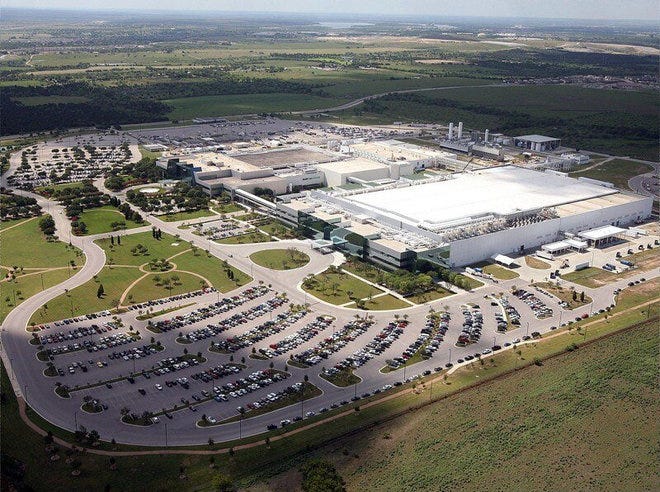
About 30 miles north of Austin, Texas, lies the small town of Taylor. And it is here where Samsung is now building a $17 billion semiconductor fabrication plant on a 1,200-acre site.
Four hours to the north, Texas Instruments is in the early stages of making a $30 billion chip project come to fruition in Sherman, Texas. The two projects illustrate that Texas has become a prominent hub for chip manufacturing.
The Semiconductor Boom in Texas
Indeed, the Lone Star State has seen more than 50 new semiconductor projects worth more than $210 billion since the enactment of the $52 billion CHIPS and Science Act in 2020, with over $61 billion being invested in the state, leading to the creation of more than 8,000 jobs.
The federal CHIPS Act aims to promote reshoring of semiconductor manufacturing, a strategy focused on bringing chip factories back to the United States. Currently, the U.S. heavily relies on chip imports, particularly from Taiwan and South Korea. However, concerns have arisen regarding the potential impact of China's potential invasion of Taiwan.
Taiwan, although a self-governing territory with its own government, is viewed by Beijing as part of China. Such a geopolitical situation has raised alarms about potential disruptions in the supply of semiconductors, further highlighting the importance of bolstering domestic manufacturing capabilities.
The Texas CHIPS Act: Boosting Chip Manufacturing
To further boost chip manufacturing in Texas, Gov. Greg Abbott last month signed into law the Texas CHIPS Act which establishes the Texas Semiconductor Innovation Fund. The fund will offer subsidies to chip manufacturing companies and provide matching funds to support chip design and manufacturing projects by universities and other state entities.
With $698.3 million allocated for the new fund and an additional $666.4 million for advanced research and development centers at the University of Texas at Austin and Texas A&M University, Texas hopes to further position itself as a competitive player in the national race for industry funding. The goal, of course, of creating thousands of well-paid jobs over the next decade.
UT-Austin and Texas A&M University: Advancing Chip Development
UT-Austin will receive $440 million to build fabs, which will be part of the Texas Institute for Electronics, a public-private partnership launched in 2022 that plans to become a nonprofit, independent organization this year. TIE focuses on the manufacture of the shells that contain microchips, a process known as packaging.
According to Sreenivasan, in the past few decades, there has been rapid progress in shrinking chip size and increasing capacity. However, the rate of improvement is now slowing down. TIE's objective is to create sophisticated packaging systems, incorporating various technologies on a single chip.
Texas A&M University is set to receive $200 million to establish fabs dedicated to quantum and artificial intelligence chip fabrication, along with an additional $26.4 million for the Center for Microdevices and Systems.
Yossef Elabd, the Vice Chancellor for Research at Texas A&M, told The Texas Tribune that their focus is on exploring new chemistry, materials, processes, and the next generation of chips.
Neither of the two universities will engage in commercial chip manufacturing. Instead, they will serve as pilot centers for developing cutting-edge products that meet market standards. Additionally, they will play a crucial role in training future technicians, engineers, and leaders in the semiconductor industry.
Goal: Becoming the Leading Microchip Manufacturing State
Despite U.S. companies leading in microchip design, they only manufacture 12 percent of the circuits and perform 3 pecent of the packaging. This over-reliance on the transnational supply chain leaves the country vulnerable to disruptions.
Industry experts say that Texas’ $1.4 billion CHIPS Act is one of the most significant incentive packages in the country, and one that meets the U.S. Department of Commerce’s expectations for states’ role in this sector.
Microchip companies currently have 54 facilities in the state. With about 45,000 workers, Texas has the second-largest workforce in the industry, only behind California, according to the Semiconductor Industry Association. The state is aiming to reach the top position by 2030.
Abundant Resources for Chip Manufacturing
Finding highly skilled workers remains one of the biggest challenges to bringing chip manufacturing back to the U.S.
Various companies, including Samsung, Texas Instruments, Infineon, GlobalWafers, NXP, X-FAB, Applied Materials, Apple, and Amazon, have ramped up their operations or are designing custom chips in Texas.
While Arizona leads in new chip investments with projects from Intel and Taiwan Semiconductor Manufacturing Co., Texas stands out for having the highest number of total fabs and is a close second in terms of new investments.
Samsung's new plant in Taylor, scheduled to begin operations next year, will be the site of their first advanced chips produced in the U.S., complementing their existing facilities in Austin.
“Texas is spacious, it’s huge, and then it has great support for ease of business,” Jinman Han, the head of Samsung’s U.S. chip business, told CNBC. “At the same time we are having great support from our local governments in Texas, even from the Texas governor himself.”
Texas Instruments' fab in Sherman adds to the company's long-standing legacy in the city.
“Texas Instruments went a long way in putting Sherman on the map,” David Plyler, the city’s mayor, told CNBC, adding that the new fab represents “a huge investment in our community.”
In Sherman, Texas Instruments found abundant water and power resources in the area. Local lawmakers had previously secured water rights from Lake Texoma, a large reservoir straddling the Texas-Oklahoma border, making water availability a valuable asset for economic development.
The chip manufacturing process requires significant amounts of water, making the Sherman region attractive to companies like Texas Instruments and GlobalWafers. GlobalWafers, a Taiwan-based company, chose Sherman to invest $5 billion in building the largest silicon wafer factory in the U.S., a crucial component for chip production.
Another critical factor is the power requirements for chip fabrication. Samsung's advanced chip-etching machines in Taylor, known as extreme ultraviolet (EUV) lithography machines, consume about 1 megawatt of electricity each, representing a 10 percent increase from the previous generation.
Texas operates an independent power grid, which can sometimes result in challenges during extreme weather events, as witnessed during the 2021 winter storm. To enhance reliability and resilience, 12 laws haver been passed to fortifying the power grid.
Samsung, Infineon and NXP were forced to shut down their Austin fabs temporarily during the blackout in February 2021. Samsung, Infineon and others have since switched entirely to renewable power.
More Than A Calculator Company
In 1930, Texas Instruments was established under the name Geophysical Service Inc., which it later changed to its current name in 1951. Notably, seven years after this rebranding, one of the company's engineers, Jack Kilby, applied for a patent for the integrated circuit.
This groundbreaking invention revolutionized the industry by enabling the miniaturization of chips through the creation of entire circuits, not just individual transistors, using silicon.
Over the years, Texas Instruments continued to innovate, creating products such as the first handheld electronic calculator in 1967. Despite being widely recognized for its graphing calculators used in classrooms worldwide, the company's Senior Vice President of Technology and Manufacturing, Kyle Flessner, emphasized that they are much more than just a calculator company.
With a diverse range of approximately 80,000 products shipped to 100,000 different customers, TI semiconductor chips are now present in almost every electronic device, whether it's a common household gadget or an industrial machine.
Tesla's Plans for Mexico Gain Momentum
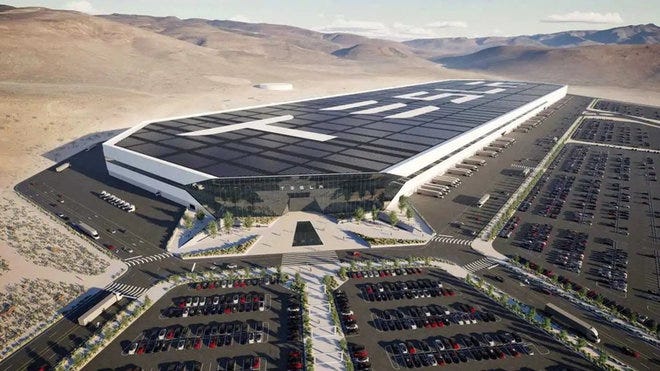
Construction will soon begin on Tesla's next assembly plant in Mexico, Despite a delay in breaking ground due to permit approvals, the governor of Nuevo León, Samuel Alejandro García Sepúlveda, has expressed optimism that construction will commence soon.
He shared that all necessary permits, including those for the environment, energy, and water, are nearing completion, and an official announcement is expected imminently.
He revealed that Tesla is in the final stages of designing a groundbreaking new model, which aims to be the world's best electric and economic car. The governor's remarks indicate that Tesla is already preparing production lines and software systems to facilitate the manufacturing process.
Tesla's Gigafactory Mexico, located near Monterrey, Nuevo León, is strategically positioned to drive the production of the automaker's next-generation vehicles. This includes a more affordable electric hatchback and the highly anticipated robotaxi vehicle.
Tesla has set ambitious goals for the factory, aiming to surpass the impressive timeline achieved by Gigafactory Shanghai, where production commenced just nine months after breaking ground.
With construction on the horizon, the prospects of Tesla's new generation vehicles are becoming increasingly tangible. The company's commitment to maintaining an affordable entry price, potentially around $25,000, holds the promise of significant market success for the forthcoming vehicle.
As final permits are soon to be obtained, the groundbreaking of Tesla Gigafactory Mexico marks a significant step forward in revolutionizing the automotive industry.
Keep reading with a 7-day free trial
Subscribe to The Rising Tide to keep reading this post and get 7 days of free access to the full post archives.